
Making your own natural face cream at home is an excellent way to learn the fundamentals of skincare formulation while having greater control over the ingredients used in your product.
Unlike a simple blend of oils and butters, a properly formulated face cream is an emulsion. It combines a water phase with an oil phase using an emulsifier to create a smooth, stable cream. Because the formulation contains water, it also requires an appropriate preservative to help protect it against microbial growth.
If you have been wondering how to make a natural face cream, this beginner-friendly guide will take you through the process step by step. You will learn which tools and ingredients you need, what each ingredient does, how to prepare the emulsion and which common formulation mistakes to avoid.
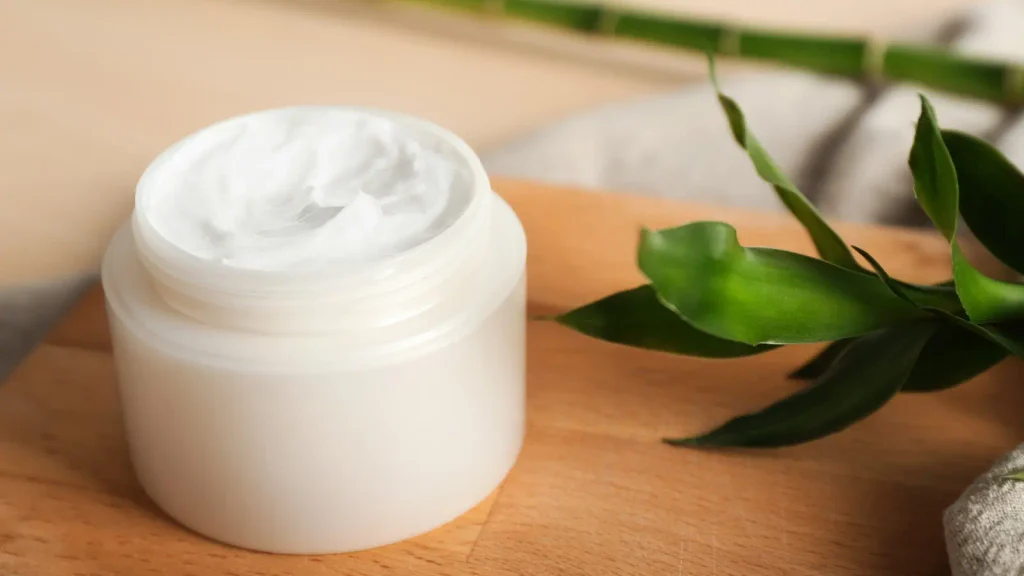
Table of Contents
What Is a Natural Face Cream?
A natural face cream is a cosmetic emulsion designed to moisturize the skin and help reduce moisture loss. It typically combines plant oils and butters with distilled water or hydrosols, together with an emulsifier that allows the oil and water phases to form a stable cream.
A water-based face cream also requires a suitable broad-spectrum preservative to help protect the formulation against bacteria, yeasts and mould.
Making your own homemade face cream also gives you greater control over the ingredients used in the formulation and allows you to adapt future recipes to different skin types and preferences.
How Does a Face Moisturizer Work?
Skin continuously loses water to the surrounding environment. A moisturizer can help reduce moisture loss while providing emollient and humectant ingredients that leave the skin feeling softer and more supple.
The performance of a face cream therefore depends on the balance between its different components. Plant oils and butters provide emolliency, humectants such as glycerin attract water and the emulsifier keeps the oil and water phases combined in a stable formulation.
What Is the Difference Between a Cream and a Lotion?
For beginners learning natural skincare formulation, understanding this distinction is useful because changing the proportion and type of oils, butters, emulsifiers, and thickeners can significantly affect the finished product.
If you’d like to see these differences in practice, explore our beginner-friendly guide on How to Make Natural Body Lotion at Home: Step-by-Step for Beginners.
Tools You Need to Make Natural Face Cream
Before making your cream, prepare suitable equipment for accurately weighing, heating, mixing and testing the formulation.
Typical equipment includes a precision scale, heat-resistant beakers, stirring utensils, a thermometer, a water bath, suitable mixing equipment and a method for checking pH.
Hygiene is particularly important when making water-containing skincare products because these formulations are susceptible to microbial contamination if they are not manufactured and preserved appropriately.
Ingredients Needed to Make a Natural Face Cream
Oil Phase
The oil phase contains the plant oils, butter and emulsifier. These ingredients contribute to the cream’s emolliency, richness, consistency and skin feel.
Water Phase
The water phase makes up the largest portion of this natural face cream recipe. Distilled water provides the aqueous base of the emulsion. Hydrosols may also be incorporated into suitable formulations.
Emulsifier
An emulsifier allows the oil and water phases to combine and form a stable emulsion. Without an appropriate emulsifier, the two phases will separate.
Functional Ingredients
Functional ingredients include humectants such as glycerin and thickeners such as xanthan gum. They can influence hydration, viscosity, stability and the sensory properties of the finished cream.
Active Ingredients
Active ingredients can be incorporated depending on the purpose of the formulation. Some are heat-sensitive and therefore need to be added during the cool-down phase.
This beginner recipe deliberately keeps the formulation simple and does not include additional actives such as panthenol or hyaluronic acid. These can be explored later as you gain experience with cosmetic formulation.
Preservative
A suitable preservative is essential for a face cream containing water. It helps protect the formulation against microbial growth, including bacteria, yeasts and mould.
Vitamin E is not a substitute for a preservative. It functions primarily as an antioxidant in this formulation.
pH Adjuster
A pH adjuster can be used when necessary to bring the finished formulation into the required pH range.
Natural Face Cream Recipe for Beginners
This beginner homemade face cream recipe combines a relatively simple oil phase with distilled water, glycerin and xanthan gum to produce a moisturizing emulsion.
Batch size: 50 g
| Phase | Ingredient | Percentage (%) | Weight (g) |
| A | Argan Oil | 10% | 5 g |
| A | Jojoba Oil | 7% | 3.5 g |
| A | Mango Butter | 3% | 1.5 g |
| A | Montanov 68 | 5% | 2.5 g |
| B | Distilled Water | 70.2% | 35.1 g |
| B | Vegetable Glycerin | 3% | 1.5 g |
| B | Xanthan Gum | 0.3% | 0.15 g |
| C | Vitamin E | 0.5% | 0.25 g |
| C | Preservative Eco | 1% | 0.5 g |
| E | pH Adjuster | As needed | As needed |
What Does Each Ingredient Do?
- Argan Oil: An emollient plant oil that helps soften the skin and contributes to the nourishing skin feel of the cream.
- Jojoba Oil: A liquid wax with good oxidative stability that provides emolliency while contributing to a lighter skin feel.
- Mango Butter: Adds richness and body to the formulation while helping soften the skin.
- Montanov 68: The emulsifier used to combine the oil and water phases and create a stable cream.
- Distilled Water: Forms the main aqueous phase of the formulation.
- Vegetable Glycerin: A humectant that attracts water and supports skin hydration.
- Xanthan Gum: Increases viscosity and contributes to the stability and consistency of the emulsion.
- Vitamin E: An antioxidant that helps protect the oils in the formulation against oxidation.
- Preservative Eco: Protects the water-containing formulation against microbial growth when used according to the supplier’s specifications.
- pH Adjuster: Used when necessary to adjust the final pH to the appropriate range.
How to Make Natural Face Cream Step by Step
1. Clean and Prepare Your Equipment
Clean your work surface, equipment and packaging thoroughly before beginning. Sanitize them using a method appropriate for the materials and allow them to dry completely.
Avoid touching surfaces that will come into direct contact with the finished cream after they have been prepared.
2. Prepare Phase A
Weigh the argan oil, jojoba oil, mango butter and Montanov 68 into a heat-resistant beaker.
3. Prepare Phase B
In a separate beaker, combine the vegetable glycerin and xanthan gum until the gum is evenly dispersed.
Add the distilled water and stir until the mixture is uniform. Pre-dispersing xanthan gum in glycerin helps reduce clumping when it is introduced into the water phase.
4. Heat Both Phases
Heat Phase A and Phase B separately to approximately 75°C (167°F). The two phases should be at similar temperatures when they are combined.
5. Emulsify the Cream
Once Phase A has completely melted and both phases have reached approximately the same temperature, gradually combine them while mixing.
Blend until a smooth, homogeneous emulsion forms. The exact mixing time will depend on the equipment and batch size.
Mixing speed, shear and duration can influence the texture and stability of an emulsion. Avoid unnecessary overmixing that introduces excessive air into the cream.
6. Cool the Emulsion
Continue stirring gently as the cream cools. The emulsion will gradually become thicker.
Do not evaluate its final consistency while it is still hot. The cream will continue developing viscosity as it cools and settles.
7. Add Vitamin E and Preservative
Once the temperature has fallen below 40°C (104°F), add the vitamin E and Preservative Eco.
Mix thoroughly to distribute the ingredients evenly throughout the cream.
Always follow the preservative supplier’s recommended usage rate, temperature requirements and pH range.
8. Check and Adjust the pH
Measure the pH using an appropriate calibrated pH meter or suitable pH test strips.
For this formulation, the target is approximately: pH 5.0–5.5
If adjustment is required, add a suitably diluted pH adjuster in very small increments, mix thoroughly and measure again before adding more.
9. Package the Face Cream
Once the cream has cooled and is homogeneous, transfer it into a clean, appropriately prepared container.
Allow the cream to settle 24 – 48 hours before evaluating its final consistency.
Common Mistakes When Making Homemade Face Cream
1. Not Cleaning and Sanitizing Equipment
Poor manufacturing hygiene increases the risk of contaminating a water-based formulation. Clean and prepare your work surface, equipment and packaging before starting.
2. Using an Inaccurate Scale
Small inaccuracies can significantly affect ingredients used at low percentages. Use an appropriate precision scale rather than measuring cosmetic formulations with kitchen spoons.
3. Combining the Phases at Very Different Temperatures
Large temperature differences between the oil and water phases can interfere with the emulsification process. Bring both phases to the required processing temperature before combining them.
4. Adding the Preservative at the Wrong Temperature
Preservatives have specific processing requirements. Follow the technical information supplied by the manufacturer rather than assuming that every preservative can be added at the same temperature.
5. Making a Water-Based Cream Without a Preservative
A water-containing cream requires an appropriate preservation system. Vitamin E and essential oils do not replace a broad-spectrum preservative.
6. Not Checking the pH
The final pH can affect both the formulation and the performance of pH-dependent preservatives. Measure it after making the cream and adjust it when necessary.
7. Overmixing the Cream
Excessive mixing can introduce unwanted air and bubbles. Use appropriate mixing conditions for the formulation and batch size.
8. Substituting Ingredients Without Reformulating
Replacing an emulsifier, preservative or other functional ingredient is not necessarily a direct one-to-one substitution. Check the supplier’s technical specifications and reformulate when required.
9. Evaluating the Texture Too Soon
An emulsion can continue to thicken as it cools. Wait approximately 24–48 hours before making a final assessment of its consistency.
10. Storing the Cream Incorrectly
Store the finished cream in suitable packaging away from excessive heat and direct sunlight.
Frequently Asked Questions About Homemade Natural Face Cream
There is no universal shelf life for homemade face cream. It depends on the preservation system, formulation, manufacturing hygiene, packaging and storage conditions.
The recipe does not contain added fragrance or essential oils, which keeps the formulation relatively simple. However, individual skin responses vary and no formulation can be guaranteed suitable for everyone with sensitive skin.
A patch test is advisable before broader facial use.
A suitable cosmetic-grade rose hydrosol can replace some or all of the distilled water if it is compatible with the formulation.
However, using a hydrosol does not eliminate the need for an appropriate preservative. It remains part of the aqueous phase.
Separation can have several causes, including unsuitable processing temperatures, insufficient or inappropriate emulsification, an unsuitable emulsifier level, ingredient incompatibilities or changes to the original formulation.
If you modify the recipe, the stability of the original formulation should not be assumed.
Essential oils can be incorporated only when they are appropriate for the intended facial product and used within a safe concentration for the specific oil.
There is no single percentage that is automatically safe for every essential oil. Some have considerably lower dermal limits or additional restrictions. For sensitive facial skin, a fragrance-free formulation is often the simpler option.
Conclusion
Learning how to make a natural face cream at home is a useful introduction to cosmetic formulation because it teaches several fundamental skills at once: accurate weighing, working with oil and water phases, emulsification, preservation and pH adjustment.
For beginners, it is better to start with a straightforward formulation and follow the percentages and processing method carefully before experimenting with substitutions or additional active ingredients. Once you understand the fundamentals, you can progress to more advanced natural skincare formulations designed for different skin types and product textures.
If you’d like to explore another beginner-friendly skincare formulation, learn How to Make Natural Body Lotion at Home: Step-by-Step for Beginners and How to Make Natural Liquid Hand Soap at Home: Beginner Recipe.